
New Books
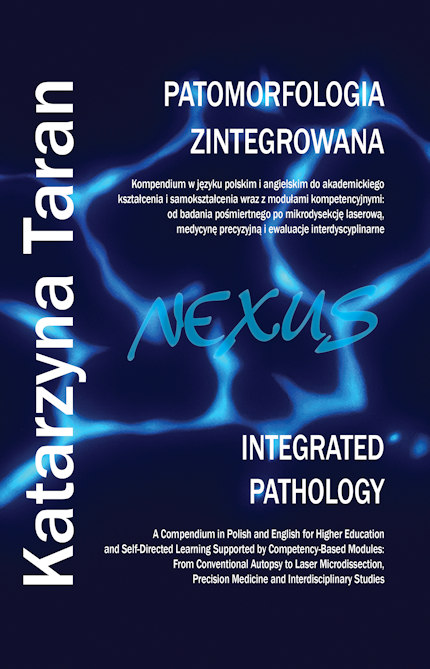
Integrated Pathology
A Compendium in Polish and English for Higher Education and Self-Directed Learning Supported by Competency-Based Modules: From Conventional Autopsy to Laser Microdissection, Precision Medicine and Interdisciplinary Studies
Katarzyna Taran
Kraków 2026
ISBN 978-83-67491-71-6
Today’s pathology is the nexus of the changes that have taken place in science and in the world around us. It has travelled a long way from postmortem examination to interdisciplinary studies, revealing the dynamics of pathological processes at the level of atomic nuclei. At present, it is becoming a science for new generations – Rudolf Virchow’s fundamental cell theory is initiating an evolution of the human body intended to enable us to inhabit outer space. Deeply rooted in its tradition yet looking to the future, pathology remains an art and continues to demonstrate that it is human imagination that ultimately governs the world.
TYOUR HIGH-YIELD GUIDE TO MASTERING PATHOMORPHOLOGY
PART I. MATERIALS FOR THE PATHOLOGY COURSE
The materials for this pathology course include content intended for both Polish-speaking and English-speaking students, in accordance with the needs they have expressed. They include materials for the author’s lectures in Polish, containing selected, structured, and up-to-date information that Polish students most often seek in English-language literature and additional sources, as well as universal resources designed to support examination preparation for both Polish-speaking and English-speaking students, including:
- high-yield core competency domains that identify the knowledge of greatest importance for acquiring competencies in the field of pathology;
- a list of flipped-learning topics important for preparation for classes, assessments, and the examination;
- a selection of slides for practical classes with competency-based relevance.
This section presents issues in a holistic manner and includes above-standard information, cross-sectional analyses and summaries. It also demonstrates the value of learning and provides examples of how the acquired knowledge, skills, and competencies can be applied in pathology and clinical practice.
PART II. COMPETENCY-BASED MODULES AT THE INITIAL STAGE OF THE DEVELOPMENT OF SKILLS AND COMPETENCIES
The competency modules are universal in character. Based on neuroscience research and the author’s many years of teaching and mentoring experience, they offer Polish-speaking and English-speaking students alike the most effective ways of building competencies – from basic morphological analysis, through the field of histoclinics, to critical analysis using virtual reality technology.
The competency modules of the compendium implement the most advanced innovative teaching methodologies in academic pathology education, such as flipped learning, progressive learning, reciprocal learning, inquiry-based learning, peer feedback learning, blended learning, microcycle learning, the jigsaw method, and learning supported by virtual reality techniques and AI resources. Furthermore, they include so-called 1-minute and 15-minute documents, which enable concise and essential presentations of the most important aspects of the topics discussed, as expected by contemporary students.
This section is intended to systematize knowledge and to introduce and develop competencies through practical tasks that draw attention to the most pressing current medical issues and the challenges of the future (including cancer, epidemic diseases, the health effects of environmental pollution, and the consumption of ultra-processed food). It also provides feedback, conclusions, and final take-home messages. In addition, the modules are designed to help English-speaking students adapt effectively to the distinct features of pathology within the prevailing educational model (or the separate disciplines of pathomorphology and pathophysiology in those countries where this distinction is maintained).*
- Throughout the English-language part of this book, the term pathology (specifically anatomical pathology) is used in accordance with standard English-language medical nomenclature. This differs from usage in some countries, such as Poland, where the disciplines of pathomorphology (anatomical pathology) and pathophysiology are traditionally distinguished as separate subjects.
PART III. SELF-DEVELOPMENT RESOURCES
The self-development resources are likewise universal in character, but operate at the level of developing meta-competencies. Drawing on the most effective strategies derived from neuroscience, this section is intended to support self-development and the growth of operational empathy. It contains tasks corresponding to the topics covered in the earlier parts of the compendium, together with answers, tags, and explanations, serving as suggested starting points for further autonomous learning.
The resources include:
- pathological processes in the past and today: a multiple-choice and multiple-response tests, together with self-development tasks (competency-based spaced repetition);
- pathological processes as a continuum: competency-based tasks using morphological images (reflective self-assessment);
- pathological processes in clinical practice: a competency-based competency worksheet for clinical situations (an introduction to metacognitive thinking).
This part of the compendium also includes a list of recognized sources recommended for study and for monitoring learning progress.
‘As a pathologist and interdisciplinary researcher of tumor cell biology, Professor Taran [MD, PhD, Professor of Pathology at the Medical University of Lodz and Andrzej Frycz Modrzewski Krakow University, Poland, expert reviewer at Minerva-Weizmann Foundation] is considered a pioneer in the evaluation of cancer tissue isotopic composition in vivo, and she’s the head of the first medical unit dedicated to the study of an atomic structure in pathological processes. Professor Taran has also made her mark as an educator, winning numerous awards for outstanding didactic achievements and for her unconventional teaching methods which stress interactivity and student engagement. As the creator of an educational project focused on modern neuro-didactics, she has successfully introduced future physicians to contemporary learning techniques that emphasize lifelong learning and competencies of the future. Beyond her work at the university, Professor Taran is active as a shooting sports certified coach and referee, a healthy life style activist and a sports advocate.’ (Michael Carrese from the ‘Raise the Line with Osmosis from Elsevier,’ Katarzyna Taran: Equipping Today’s Medical Students to Manage Uncertainty)
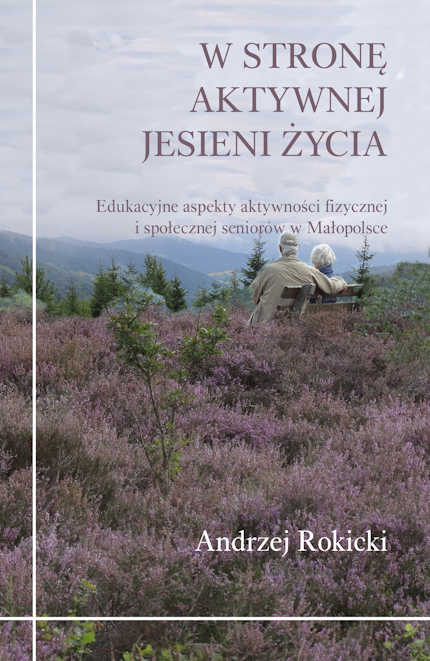
W stronę aktywnej jesieni życia. Edukacyjne aspekty aktywności fizycznej i społecznej seniorów w Małopolsce
Andrzej Rokicki
Kraków 2026
e-ISBN 978-83-67491-51-8
DOI 10.31749/978-83-67491-51-8
W społeczeństwie polskim coraz więcej osób starszych pozostaje aktywnych, cieszy się dobrym zdrowiem i podejmuje różnorodne działania zarówno w wymiarze osobistym, rodzinnym, jak i społecznym. Wciąż jednak duża część pozostaje bierna, unika nowych wyzwań i aktywności, a na skutek szybko zachodzących zmian w świecie, wynikających m.in. z transformacji modelu rodziny, postępu technologicznego czy izolacji społecznej, nie potrafi dobrze sobie radzić w codziennym życiu.
Przemiany demograficzne charakteryzujące najbardziej rozwinięte kraje świata dotyczą także Polski. Ich efektem jest znaczny i systematyczny wzrost liczby osób w wieku senioralnym, co przy jednoczesnym spadku urodzeń prowadzi do coraz większych wyzwań zarówno w kwestii opieki medycznej, jak i zabezpieczenia ekonomicznego. Oprócz aspektów fundamentalnych równie ważne w odniesieniu do osób starszych są takie kwestie jak ogólny dobrostan, satysfakcja życiowa czy relacje międzypokoleniowe.
W tym kontekście istotny jest proces edukacji dorosłych, który trwa całe życie, jest zjawiskiem wielowymiarowym, nakierowanym na lepsze zrozumienie zachodzących zmian, otaczającego świata. Edukacja może przyczyniać się do afirmacji życia, zwiększenia poczucia życiowego zadowolenia oraz może zapobiegać nudzie i atrofii rozwojowej.